
The Free Food Initiative is a non-profit organization with a bold and simple vision: produce food at scale using fully automated robotic farming and distribute it freely to every person on Earth.
Hunger is not a problem of scarcity. The world produces more than enough food to feed every person alive. The problem is one of economics, logistics, and incentives. Food production is expensive because it relies on human labor, complex supply chains, and profit-driven distribution. We believe that by removing labor costs through full automation and by operating as a 100% non-profit, we can break this cycle and make free food a reality.
Our approach is straightforward. We acquire affordable farmland in regions where land is plentiful and inexpensive, starting with Brazil. Brazil offers vast tracts of fertile agricultural land at a fraction of the cost found in North America or Europe, combined with favorable growing conditions that support year-round production. From there, we deploy state-of-the-art autonomous farming robots sourced from leading Chinese high-tech manufacturing companies. These robots handle everything from soil preparation and planting to irrigation, pest management, harvesting, and packaging.
By eliminating the single largest cost in food production — human labor — and by operating without the need for profit margins, we can produce staple foods at costs that approach the raw material inputs alone: seeds, water, and energy. The result is food that can be distributed freely.
This initiative is entirely funded through voluntary donations from individuals and organizations who share our belief that access to food is a fundamental human right. Every dollar donated goes directly toward acquiring land, deploying robots, and distributing food. There are no shareholders, no dividends, and no executive bonuses. We exist for one reason: to feed people.
We are starting in Brazil, but our ambition is global. As we prove the model works, we will expand to other regions with affordable farmland — sub-Saharan Africa, Southeast Asia, Central America, and beyond. The technology is scalable. The need is universal. The only limiting factor is resources, and that is where you come in.
Brazil is the world's third-largest agricultural producer with over 60 million hectares of available arable land. Land prices in Brazil's interior regions are among the lowest in the world for fertile, productive soil. The climate supports multiple growing seasons per year, and the country already has well-established agricultural infrastructure.
Starting in Brazil allows us to maximize the impact of every donation dollar. Where a single acre of farmland in the United States might cost $5,000 or more, equivalent quality land in Brazil's expanding agricultural frontier can be acquired for a fraction of that. This means more land, more food, and more people fed per dollar donated.
Brazil's strategic location and existing agricultural infrastructure make it the ideal launchpad for a global initiative. By establishing our first automated farms here, we can begin distributing free food to nearby communities almost immediately, demonstrating the viability of the model before scaling to serve every person on the planet.
Traditional farming is labor-intensive. Labor typically accounts for 40-60% of total production costs for staple crops. By replacing human labor with autonomous robots, we eliminate this cost entirely. Modern agricultural robots can work 24 hours a day, 7 days a week, in any weather conditions, with precision that exceeds human capability.
We source our robotic systems from leading Chinese high-tech manufacturing companies. China has emerged as the global leader in affordable, high-quality industrial and agricultural robotics. Chinese manufacturers offer autonomous tractors, precision seeders, drone-based crop monitoring, robotic harvesters, and AI-driven irrigation systems at price points that make large-scale deployment economically viable for a non-profit operation.
The robots are guided by AI and satellite imagery to optimize every aspect of farming: planting density, water usage, fertilizer application, and harvest timing. This precision approach not only reduces costs but also improves yields and minimizes environmental impact compared to traditional farming methods.
There is a lot of fear right now about AI taking people's jobs. Whether or not that fear is justified, it is telling us something important. It is an opportunity — maybe the first real one — for all of humanity to reflect on the way we have structured our society. Why are most people living paycheck to paycheck? Why does so much of our potential go to waste just keeping the lights on?
The AI conversation is real, and so is the opportunity it has created. The right response is not fear — it is action. A giant step towards a world where the basics are taken care of and people are free to focus on bettering themselves. A world where everything is abundant. That is the vision behind the Free Food Initiative.
If you can automate the production and distribution of something as fundamental as food, you have proven the model. The same approach — automation, non-profit, free for everyone — can be applied to housing, energy, clothing, and beyond. Free food is the stepping stone towards a world where everything is abundant.

We use donations to purchase affordable, fertile farmland in Brazil and other regions where land prices are low. Every acre acquired is held in trust by the Free Food Initiative and dedicated permanently to food production.

We equip each farm with autonomous farming robots sourced from Chinese high-tech companies. These machines handle planting, watering, monitoring, pest control, and harvesting with zero human labor required.

With robots running around the clock and AI optimizing every decision, our farms produce staple crops at maximum efficiency. No labor costs mean near-zero production costs — just seeds, water, and sunlight.
Harvested food is distributed at no cost to everyone. We partner with local organizations and community centers to make free food available to all people, starting with communities near our farms and expanding outward.
The Free Food Initiative is a fully non-profit organization. We have no shareholders, no profit margins, and no executive bonuses. Every single dollar donated goes directly toward our mission: acquiring land, deploying robots, and distributing free food. Our financial records are open and auditable. We exist to feed people, not to generate wealth.

Trust is earned through openness. We publish detailed reports on how every dollar is spent, from land purchases to robot deployments to food distribution volumes. Our operations, finances, and decision-making processes are fully transparent. Donors and the public can track exactly where their contributions go and what impact they have.

We are committed to farming practices that protect and enrich the land for future generations. Our AI-driven precision agriculture minimizes water waste, reduces fertilizer runoff, prevents soil degradation, and eliminates the need for harmful pesticides. We aim to produce food in a way that heals the environment rather than harming it. Sustainable farming is not just good ethics — it is good economics.

This initiative is powered by the generosity of ordinary people. We are not backed by governments or corporations. Our funding comes entirely from voluntary donations by individuals and organizations who believe in a world without hunger. This independence ensures our mission remains pure and our priorities are set by the communities we serve, not by political or commercial interests.

We believe that technology is the key to solving humanity's oldest problems. By leveraging cutting-edge robotics, artificial intelligence, satellite imaging, and precision agriculture, we can achieve what was previously impossible: producing food at near-zero marginal cost. We continuously seek out and adopt the most advanced and cost-effective technologies available globally.

Food is a human right, not a privilege. The Free Food Initiative distributes food freely to every person, everywhere — without conditions, without restrictions, and without discrimination. Everyone eats. It is that simple. We believe that when food is universally free, humanity is liberated to pursue education, creativity, and fulfillment — unlocking human potential on a global scale.
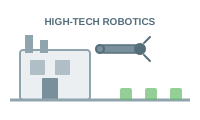
Our robotic farming fleet is sourced from leading Chinese high-tech manufacturing companies, which have become global leaders in affordable, industrial-grade agricultural automation. Our fleet includes autonomous tractors that can plow and prepare fields without human operators, precision seeding machines that optimize plant spacing for maximum yield, drone systems for aerial crop monitoring and targeted pest management, robotic harvesters capable of picking and sorting produce around the clock, and AI-driven irrigation systems that deliver exactly the right amount of water to each section of field based on real-time soil and weather data.
Chinese manufacturers offer these systems at price points that are 40-60% lower than equivalent Western-manufactured equipment, without compromising on quality or capability. This cost advantage is critical for a non-profit operation and allows us to deploy more robots across more farmland with every dollar donated.

Every decision on our farms is guided by data. Satellite imagery provides daily overviews of crop health across all our farmland. On-ground sensors continuously monitor soil moisture, nutrient levels, pH, and temperature. Weather data is integrated in real-time to adjust irrigation and harvesting schedules.
Our central AI system synthesizes all this data to make decisions that would take teams of agronomists to replicate: when to plant, how densely, when to irrigate, when to harvest. The result is yields that consistently exceed traditional farming methods by 20-30%, while using less water and fewer inputs. This is not farming as usual — this is farming reimagined from first principles, optimized for one goal: producing the maximum amount of nutritious food at the minimum possible cost, so it can be given away for free.

The Free Food Initiative is funded entirely by voluntary donations. We do not receive government funding, corporate sponsorship, or venture capital. Our independence is our strength — it means our only obligation is to humanity.
Every dollar you contribute goes directly to our three core operations:
Purchasing fertile farmland in affordable regions, starting with Brazil's agricultural frontier. More land means more food.
Sourcing and deploying autonomous farming robots from Chinese high-tech manufacturers. More robots means higher productivity.
Getting harvested food to people everywhere through local partnerships and global distribution networks. More reach means free food for more people.
We publish quarterly financial reports detailing exactly how funds are allocated. We have zero administrative overhead — our team is volunteer-driven and our robots do not require salaries. When you donate to the Free Food Initiative, you are not funding a bureaucracy. You are buying land, building farms, and feeding people.
We accept donations of any size. Whether you can give $5 or $50,000, every contribution brings us closer to a world where food is free for everyone. Recurring monthly donations help us plan and scale our operations predictably.
To make a donation or to learn more about the collection initiative, please contact us using the information below. We are currently establishing formal payment channels and will update this section with direct donation links as they become available.